

Packaging Basics
Paperboard or Corrugated: Which One Does Your Product Need
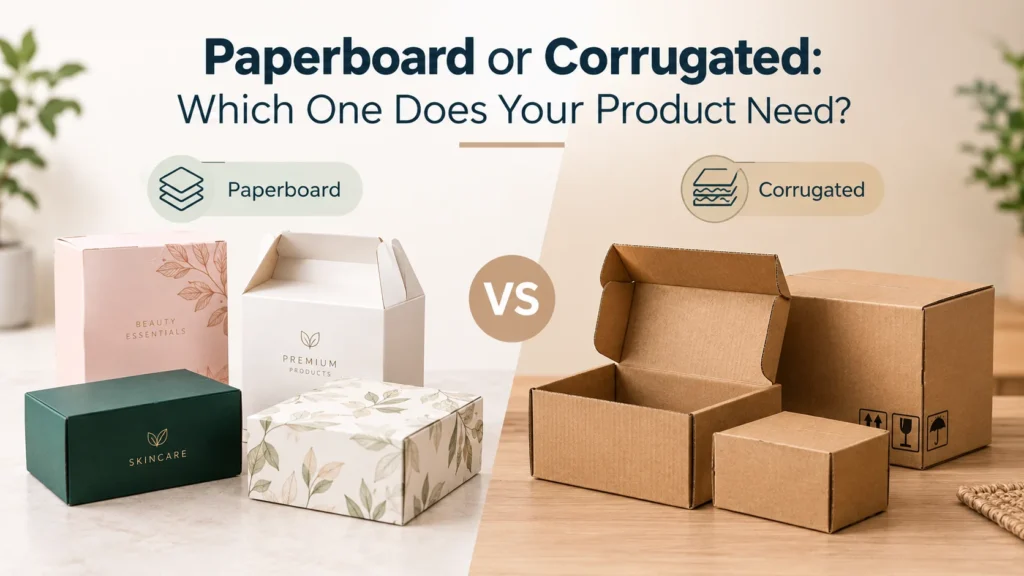
There is a line in packaging that sits at about two pounds. Below that line most products belong in paperboard. Above it or whenever the box travels on its own through a courier network, they belong in corrugated.
That single threshold settles most material questions, and getting it wrong is the most expensive mistake in packaging because you only find out after the boxes are printed. This post covers why the line sits where it does and what the numbers on a spec sheet actually mean. It also covers when you need both materials on the same job.
Paperboard is one layer and corrugated is three
Paperboard, often called folding carton board or SBS, is a single solid layer of fiber. It is smooth and it takes print beautifully, and it folds crisply along a crease. Thickness is measured in GSM or in points. GSM is grams per square meter and a point is one thousandth of an inch.
Corrugated is three layers glued together, with two flat liners and a wavy fluted layer between them. That wave is the whole point of it. It creates air columns that absorb impact and resist crushing, which is why a corrugated box survives being stacked and a paperboard one does not.
| Material | Typical spec | What it suits |
|---|---|---|
| Lightweight carton board | 300 to 350 GSM SBS, about 16 pt | Single retail items, cosmetics, soap, confectionery |
| Heavier carton board | 350 to 400 GSM SBS, about 20 pt | Gift sets, multi piece packs, larger cartons |
| Rigid greyboard | 1.5 to 2 mm with a printed wrap | Premium gifting, spirits, jewelry |
| E flute corrugated | About 1.5 mm thick, 32 ECT | Direct to consumer mailers, retail shippers |
| B flute corrugated | About 3 mm thick, 44 ECT | Heavy contents, several units per outer |
Notice that corrugated is described by flute and ECT while paperboard is described by GSM instead. Those measure different things, which is where most confusion starts.
Flute letters are thickness and ECT is strength
The flute letter tells you how thick the wave is. It is not a ranking and the letters are not in order of size for historical reasons.
- F flute is about 0.8 mm, used for small retail boxes where you want corrugated protection in a slim pack
- E flute is about 1.5 mm, the standard for printed mailers and retail shippers
- B flute is about 3 mm, the standard for heavier cartons and outers
- C flute is about 4 mm, used for large shipping cases
ECT stands for edge crush test and it measures how much force the board takes on its edge before it fails, in pounds per inch. A 32 ECT board is the common grade for mailers. A 44 ECT board is roughly a third stronger and it is what you want when boxes get stacked several high on a pallet.
Thickness and strength move together but they are not the same thing, because you can have a thick board with weak liners. When you specify corrugated, give both the flute and the ECT because a supplier quoting only the flute has left the important half out.
Board thickness changes the outside of your box
This is the practical reason the two materials cannot be swapped late in a job. Each one takes up a different amount of space on the finished box.
| Material | Added to each outside dimension |
|---|---|
| 300 to 350 GSM carton | About 0.8 mm |
| 350 to 400 GSM carton | About 1 mm |
| E flute corrugated | About 3 mm |
| B flute corrugated | About 6 mm |
A 200 by 150 by 80 mm internal box in 350 GSM board measures about 201 by 151 by 81 mm outside. The same internal size in B flute measures about 206 by 156 by 86 mm. The corrugated version will not fit if your shelf space or your shipper or your pallet pattern was planned around the carton figure.
Always quote internal dimensions and let the material decide the outside. That is the only way a switch between materials stays safe.
Sometimes you need both materials
A lot of products use both materials and people treat this as an upsell when it is usually the cheapest correct answer.
The printed folding carton is your retail pack and it sits on a shelf, carries the branding and has to look excellent up close. The corrugated outer is what gets it there. That outer carries a shipping label, it protects a dozen cartons and nobody ever sees it on display.
Trying to make one box do both jobs is where money gets wasted. A corrugated box printed to retail quality costs far more than a carton because the fluted surface never takes ink as cleanly as flat board. A carton strong enough to ship alone has to be so heavy that it stops folding well.
Run the nice print on the carton and keep the outer plain. Your unit cost drops and both boxes do the job they are built for.
Print quality genuinely differs
Flat paperboard is one of the best printing surfaces in packaging. Fine type holds, gradients stay smooth and a solid stays solid.
Corrugated has the flute underneath the liner, and under pressure that structure telegraphs through as faint stripes across large solid areas. It is called washboarding and it shows most on dark solids and on photographic images. Litho lamination where a printed sheet is laminated onto corrugated, avoids it but it costs more and adds a step.
So if the design depends on a deep solid color across the whole panel, that is an argument for keeping the printed element in paperboard. If the corrugated has to be printed, design around it. Lighter backgrounds, bolder shapes and less fine detail all survive on flute.
Recycling is simpler than most claims suggest
Both materials recycle in standard curbside streams as long as you do not add barriers that are hard to separate.
Uncoated or matte varnished board with a water based print recycles cleanly. Foil stamping is a small enough area that it goes through fine. Full foil lamination, plastic windows and poly coatings all change the answer because the material stops being a paper stream.
If recyclability is a genuine requirement rather than a marketing line, the practical rule is to keep barriers in a separable inner and keep the outer paper. That is defensible, specific and it does not rely on a vague eco claim.
What to send us
Tell us what the product weighs packed and whether the box ships on its own. Those two answers put you on the right side of the two pound line and everything else follows from there.
The minimum is 100 boxes per size and per design in either material and there is no setup or tooling charge. Production is 8 to 12 business days after dieline approval. A plain structural sample takes 3 to 5 working days and a printed sample takes 7 to 10. You hold the actual box before the full run starts.That is the cheapest way to settle a material argument because you can drop the sample on a floor and see what happens.
Email Sales@boxesexpert.com and we will quote both materials if you are unsure so you can compare the unit price before you decide.
