

Packaging Basics
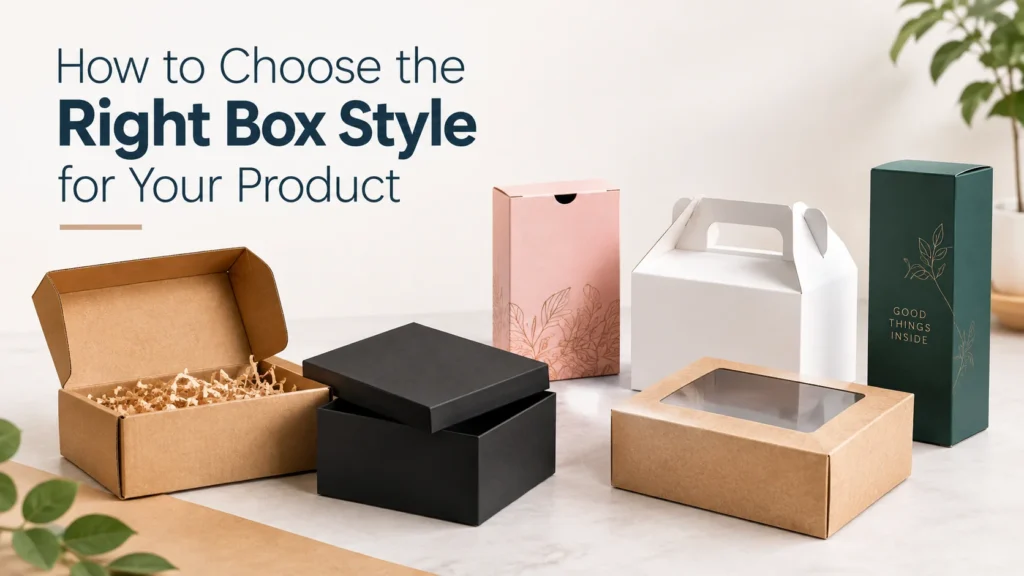
How to Choose the Right Box Style for Your Product
Packaging Basics
Most people pick a box style by looking at pictures. That works right up until the first pallet arrives and the boxes pop open in transit, or the retailer says the pack will not stand on a shelf.
Box style is a structural decision before it is a visual one. It sets how the box closes and how much weight the base can carry. It also sets how fast someone can pack it and whether it survives a courier without an outer carton. Get the style right and the printing has something solid to sit on. Get it wrong and no amount of foil fixes it.
Here is the order we work through when a customer asks which style they need.
Start with weight and whether the box travels alone
Two questions decide most of it. How heavy is the packed product and does the box ship on its own or inside something else?
A 90 gram soap bar going onto a shelf and a 1.2 kilogram candle set going to a customer’s door are different engineering problems. The soap needs a carton that looks good and opens cleanly. The candle set needs a base that will not burst and walls that will not crush under three more parcels.
| Your situation | The style that usually fits |
|---|---|
| Light retail item, under about a pound, sold on a shelf | Straight or reverse tuck end carton |
| Heavier retail item, over about a pound | Auto lock bottom carton |
| Several flavors or scents on one shape | Sleeve over a printed tray |
| Premium gift and the unboxing matters | Two piece rigid box |
| Ships direct to a customer with no outer | Corrugated mailer |
| Small light item, favors and samples | Pillow box |
| Sold from a counter display | Display box with a printed header |
That table gets you into the right family of styles. The rest of this post is what separates the options inside each one.
Tuck end cartons cover most retail work
A tuck end carton is a flat folding carton with flaps that tuck into the body at both ends. It is the most common piece of retail packaging in the world because it is cheap to make, fast to pack and it prints beautifully on flat board.
There are two versions and the difference matters more than it sounds.
A straight tuck end has both flaps folding in the same direction so the tuck lines up at the back on both ends. The front face stays completely clean, which is what you want when the front panel carries the whole design.
A reverse tuck end has the flaps folding in opposite directions. It costs slightly less to die cut because the shape nests more efficiently on the sheet but one tuck edge shows on the front. On a busy design nobody notices that edge but on a minimal design with a lot of white space you certainly will.
Use 300 to 350 GSM SBS for a single item and 350 to 400 GSM once the carton gets larger or holds more than one piece. Below 300 GSM the panels bow and the box looks cheap on a shelf even when the print is good.
Auto lock bottom earns its cost above about a pound
An auto lock bottom carton, sometimes called a crash lock, has a base that locks itself as you square the box up. The glue is applied in the factory and the base snaps into a locked position rather than relying on tucked flaps.
It costs more than a tuck end because there is more glue work and a more complex die. You get two things back for that extra cost. The base holds far more weight without bursting and a packer squares the box in one movement rather than folding four flaps. On a line packing a few hundred units a day, that second point matters more than the first.
The rough threshold sits at about a pound and below that a tuck end base is perfectly fine. Above it a tuck bottom starts to sag and eventually gives way at the worst moment, which is usually while a customer is carrying it.
A sleeve over a tray is the cheapest way to run variants
If you sell the same product in six scents, six separate printed cartons means six dies, six artwork files and six minimums. A sleeve over a tray changes all of that.
You run one base tray in plain kraft or a single printed design and slide a printed sleeve over it. The sleeve is what carries the variant artwork. When you add a seventh scent you print a seventh sleeve and the tray underneath never changes.
The die stays the same, the tray stock stays the same and only the cheapest component gets reprinted. For seasonal ranges and flavor lines this is usually the lowest total cost and it is the option most brands find out about too late.
Two piece rigid is a different product, not a better carton
A two piece rigid box is a lid and a base made from 1.5 to 2 mm greyboard with a printed paper wrap. It does not fold flat, it ships assembled and it costs several times what a folding carton costs.
People compare it to a carton and conclude it is the premium version of the same thing. It is not the same thing at all and it is a different product doing a different job. Rigid is for a box the customer keeps, opens slowly and possibly reuses. Jewelry, spirits, high value cosmetics and corporate gifts all justify it.
If the box gets torn open and dropped in a bin within ten seconds, rigid is money spent where nobody was watching. Put that budget into a better finish on a folding carton instead.
Rigid takes 10 to 12 business days to produce rather than 8 to 12 because the wrapping is a separate operation after the board is cut.
Mailers are for the box that travels alone
A corrugated mailer is the style you need when there is no outer carton protecting your box. It has a self locking base, side wings and a front tuck and it is made from fluted board rather than flat paperboard.
Use E flute at 32 ECT for a normal direct to consumer parcel. E flute is about 1.5 mm thick, which is enough to absorb a knock without making the pack feel bulky. Move up to B flute at 44 ECT when the contents are heavy or when several retail units travel in one box.
The common mistake is using a printed folding carton as a shipper. Paperboard has no cushioning layer so the corners crush and the print scuffs. Once the packed weight passes about two pounds or whenever the box goes into a courier network naked, move to corrugated.
What to send us
Tell us what the product is and what it weighs packed. Tell us whether the box ships on its own or inside an outer carton. That is usually enough for us to recommend a style and cut you a dieline.
The minimum is 100 boxes per size and per design and there is no setup or tooling charge. Production runs 8 to 12 business days after you approve the dieline, and 10 to 12 for rigid. A plain structural sample takes 3 to 5 working days and a printed sample takes 7 to 10. You hold the actual box before the full run starts. so you can hold the style in your hand before you commit to a run.
If you already know the style and just need the dimensions right, our box measurement guide covers how to measure a product and how much clearance to add.
Email Sales@boxesexpert.com with your product details and we will come back with a dieline and a price.
