

Packaging Basics
What Actually Drives the Cost of Custom Packaging
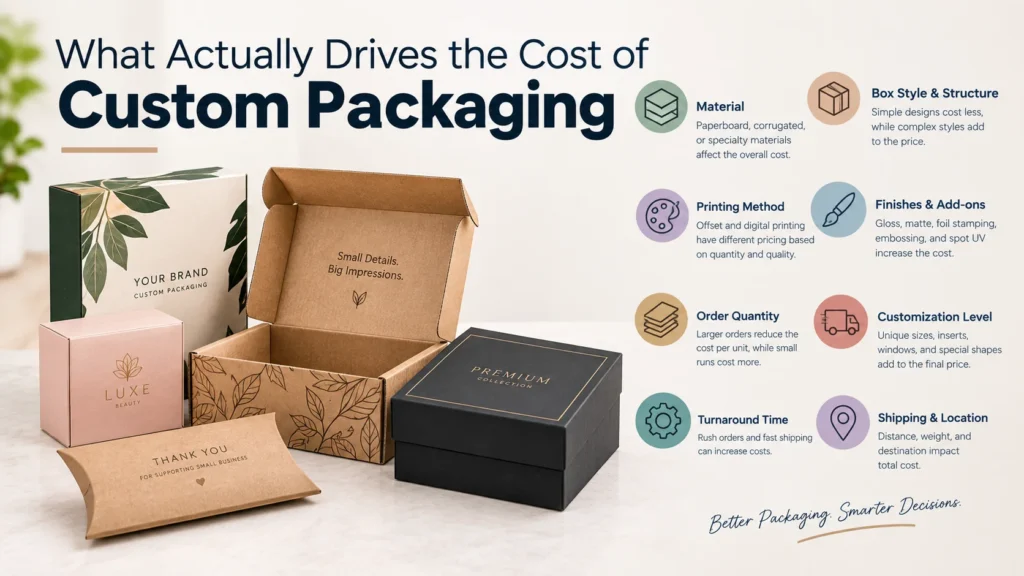
Packaging quotes feel like a black box to most buyers. Two suppliers quote the same brief and the numbers come back forty percent apart, with no explanation of what moved.
There is no real mystery in any of it. Six things drive the unit price on a custom box and they do not carry equal weight. If you know the order, you can cut a quote down without cutting the quality anyone sees.
Here they are, ranked by how much each one actually moves the number.
| Cost driver | How much it moves the price | What you can do about it |
|---|---|---|
| Quantity | The largest lever by a wide margin | Order to the price break rather than just under it |
| Print colors | Large on offset, small on digital | Build the design on two or three colors |
| Board grade | Moderate and it compounds into shipping | Match the board to the packed weight, not the shelf look |
| Special finishes | Moderate, one step per finish | Choose one feature finish rather than three |
| Insert | Moderate, it is a second product | Use a one piece folded insert where the product allows |
| Size and shape | Small but real, through sheet efficiency | Ask whether a few millimeters changes the yield |
Quantity moves the price further than anything else
A box has fixed costs that happen once no matter how many you print. Setting the press, making the die and getting the color right on the first sheets all happen once. Those fixed costs then get divided by your quantity.
At 100 units they are spread thinly across very few boxes. At 1,000 they are spread across ten times as many. That is why the unit price falls as the quantity climbs, and why it falls fastest in the early part of the curve.
Our price break lands at 1,000 units on the same artwork. Below that the unit price stays flat, which has a practical consequence worth knowing. Splitting one design across two orders of 500 saves you nothing because neither order reaches the break. If your forecast supports the 1,000, take it in one run.
The other thing quantity buys you is calendar time. A single run of 1,000 takes 8 to 12 business days once. Two runs of 500 take that twice and the second one waits behind whatever else is on the press.
Print colors cost plates, not ink
On offset, every color in your design needs its own plate and its own pass through the press. Four colors means four plates and four passes while one color means one of each.
This is why a two color design on kraft board often costs meaningfully less than a full color design on white board. Both boxes can look equally considered from the outside. The ink itself is close to free but the plates and the press time are not.
On digital printing the picture changes completely. There are no plates so color count barely affects the price. A full color design costs roughly what a one color design costs, which is another reason short runs belong on digital.
The design advice that follows from this is worth more than any discount. Build a strong design on two or three colors and let the board and the finish carry the rest. A one color foil on uncoated kraft looks expensive and costs less than a four color process print.
Board grade compounds into shipping
Heavier board costs more per sheet and that part of it is obvious to everyone.
The part people miss is that it costs more to move as well. A pallet of 400 GSM cartons weighs more than the same pallet in 300 GSM and weight is what freight prices on. If you are shipping thousands of units, the board decision follows you all the way to the customer.
The answer is not to go as light as possible. A carton that bows on a shelf undoes the whole design. The answer is to match the grade to the packed weight. Use 300 to 350 GSM SBS for a single retail item and 350 to 400 GSM once the pack gets larger or holds several pieces. Move to corrugated once the packed weight passes about two pounds because at that point paperboard is failing rather than saving you money.
Finishes add steps rather than percentages
Lamination, spot UV, hot foil and embossing are each a separate operation after printing. Each one is another machine, another setup and another day in the schedule.
That means finishes stack in steps rather than percentages. One finish adds one step and three finishes add three, and the third one rarely gets noticed next to the first two.
If the budget is tight, keep the lamination and drop the rest. Lamination is the only finish that also does a job because it protects the print through the supply chain. Everything else is purely decorative, which is fine when it is chosen deliberately and expensive when it is chosen by habit.
An insert is a second product
An insert needs its own die and its own material, and sometimes its own machine. When you add one, you have added a second item to the job rather than a feature to the first one.
Sometimes an insert is genuinely unavoidable on a job. Multi piece sets, fragile items and anything that would rattle all need one. When you do need one, the material choice moves the cost significantly. A one piece folded paperboard divider is the cheapest option and it recycles with the carton. Molded pulp costs more than that and grips irregular shapes better. Vacuum formed plastic gives the most precise fit and costs the most, both to buy and to justify on recyclability.
Ask whether the structure can do the insert’s job first. A carton with a built in platform or a locking tab often holds a product perfectly well. It costs nothing extra because it comes out of the same die.
Size matters through how the shape nests
Boxes are cut from large sheets of board. How many of your boxes fit on one sheet is called the yield and it moves the unit cost more than the size difference suggests.
A box that is five millimeters too big can drop the yield from eight per sheet down to six. That is a twenty five percent jump in board cost for a change nobody would notice on a shelf.
You will not know where those thresholds sit and you do not need to. Just ask the question when you brief the job to us. If a few millimeters either way is acceptable to you, say so and we will tell you whether adjusting the size improves the yield.
What does not cost anything here
Some of what gets quoted as a cost elsewhere does not appear on our invoice at all. It is worth knowing which line items to question when you compare quotes.
- Setup and tooling. No charge at any quantity. The die and the plates sit inside the unit price on the first order and every one after it.
- Design support. Free at every stage, whether we are setting your file onto our dieline or building the artwork from scratch.
- Dieline and 3D mockup. Free, and you get both before you commit to anything.
- Shipping. Free worldwide on all orders so the destination does not change what you pay for the boxes.
The one thing you do pay for before a run is a sample, at $19.99, shipped in 3 to 5 business days. That charge is deliberate, because a sample in your hands is the cheapest insurance available against a reprint.
Reorders are where the savings actually land
The first order carries the work of creating the die and the plates. The second order does not carry that work because we keep them both.
That means a repeat run in the same size and artwork goes straight into production once you confirm the quantity. Nothing restarts and nothing has to be recreated. If you are choosing between two suppliers and one charges tooling on every order, the difference is not visible in the first quote. It shows up by the time you reach order three.
This is also the strongest argument for settling the size early. A size that works can be reordered for years without change. A size that nearly works gets changed and a changed size is a new die.
What to send us
Send the internal dimensions, the quantity you need and the date the boxes have to be in your hands. Tell us the board and finish you have in mind and say whether a few millimeters on the size is negotiable.
The minimum is 100 boxes per size and per design. Production runs 8 to 12 business days after you approve the dieline and 10 to 15 for rigid boxes. Artwork comes to us as an AI, EPS or PDF file set on our dieline.
Email Sales@boxesexpert.com and we will come back with a price and a dieline, with every line explained rather than bundled.
