Consultation
Send your product size, quantity and deadline. Not sure which board or style fits? Tell us what goes inside and we will specify it for you, then quote within 24 hours.




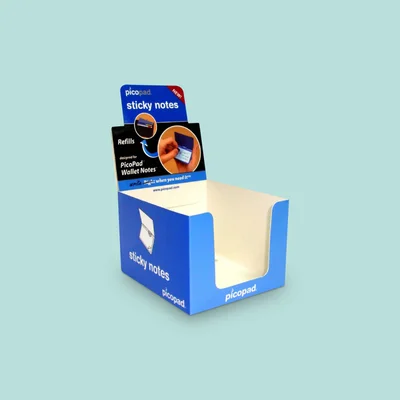

A display box is packaging that sells from the outside rather than protecting from the inside. It holds a group of units and presents them at an angle a shopper can reach without bending or searching. We print display boxes in runs from 100 units and build every one around the weight it has to hold while standing upright.
Retail space is rented space even when nobody sends you an invoice for it. A store manager gives a display a few weeks to prove it moves more product than the plain shelf it replaced. That short window is the reason every structural decision described below is made around load and speed of setup.
Get Custom Quote
| Specification | Detail |
|---|---|
| Styles | Counter display, PDQ tray, floor standing, header card, shelf ready, tiered step. |
| Counter footprint | Keep under about 12 inches square. Counter space is the most contested in any store. |
| Floor units | Height carries the work. A header at eye level does most of the selling. |
| Load under 3 lb | 24 pt SBS paperboard. Small counter units holding sachets or cosmetics. |
| Load 3 to 10 lb | E flute corrugated with a white printed liner. Most counter and PDQ work. |
| Load 10 to 30 lb | B flute corrugated with a reinforced base panel. Floor displays. |
| Load above 30 lb | BC double wall with internal support columns. Tall and multi shelf units. |
| Support columns | Hidden posts transfer load down through the structure, not across a flat panel. |
| Assembly | Ships flat and locks upright by hand. No tape and no instructions. |
| Header card | Printed panel standing above the unit. Keep it to a few words and a price. |
| Liner choice | White liner for bright color. Kraft liner costs less and suits natural ranges. |
| Finishes | Matte lamination resists the fingerprints that build on a unit shoppers touch. |
| Lifespan | Counter units run four to six weeks. Floor units last a season when restocked. |
| Sizes | Built from one retail unit and how many the display must hold. |
| Minimum order | 100 units per size and per design. |
| Production time | 8 to 12 business days after dieline approval. |
| Samples | A plain structural sample takes 3 to 5 working days and a printed sample takes 7 to 10. |
| Pricing | No setup or tooling charge. Break at 1,000 units. |
| Artwork and design | AI, EPS or PDF on our dieline. Structural work and header artwork free. |
| Shipping | Free shipping worldwide on all orders. |
A shipping box only has to arrive intact and a retail carton only has to sit still on a shelf. A display box carries its own load for weeks while shoppers pull units out of it from the front. The structure has to stay square even when it is half empty and leaning against nothing.
It also has to be ready in seconds because store staff will not spend time assembling anything. The best displays arrive flat and lock into shape with a few folds that need no tape and no instructions. Anything slower than that ends up left in a stockroom.
Those two demands pull in opposite directions since fast assembly favors light board while load bearing favors heavy board. Resolving the tension starts with deciding where in the store the unit will actually sit.
A counter display sits beside a register and competes for an impulse purchase in the last twenty seconds of a visit. It stays small because counter space is the most contested area in any store. Keep the footprint under roughly 12 inches square and keep the height low enough that staff can still see over it.
A floor display works differently because it occupies an aisle end or a walkway and has to be seen from a distance. Height becomes the main asset here and a header card lifted to eye level does most of the work. Floor units also need a base strong enough to carry the full load without spreading outward.
Knowing which of the two you are building makes the style table below much easier to read.
| Style | Where it sits | Best suited to |
|---|---|---|
| Counter display box | On the checkout counter at hand height | Lip balm candy vape pods and low priced impulse items |
| PDQ tray | Dropped straight onto a shelf with the lid removed | Grocery and pharmacy lines where staff restock quickly and often |
| Floor standing display | On an aisle end or in an open walkway | Seasonal promotions and product launches that need visible volume |
| Display box with header card | Counter or shelf with a printed panel standing above | Brands that need pricing or a claim readable from several feet away |
| Shelf ready display | Ships as a case then tears open into a facing | Retail chains that require case ready packaging in their supplier terms |
| Tiered step display | Counter or shelf with two or three rising levels | Ranges with several variants that all need a visible front face |
With the style settled the next question is what the unit has to hold without sagging.
A display fails at the base long before it fails anywhere else because every unit inside presses down on the same floor panel. Work out the total filled weight first and then pick board from the figure rather than from the look you want.
| Total load | Board we recommend | Typical use |
|---|---|---|
| Under 3 pounds | 24pt SBS paperboard | Small counter units holding sachets or cosmetics |
| 3 to 10 pounds | E flute corrugated with a white printed liner | Counter displays and PDQ trays in most retail categories |
| 10 to 30 pounds | B flute corrugated with a reinforced base panel | Floor displays holding bottles cans or boxed goods |
| Above 30 pounds | BC double wall with internal support columns | Tall floor units and multi shelf promotional stands |
Internal columns are worth explaining because they solve the tallest problem cheaply. A hidden corrugated post running from the base to the top shelf transfers load down through the structure instead of across a flat panel. That single addition often lets a unit hold twice the weight for a very small increase in cost.
Plan the lifespan of the unit before you order a quantity. A counter display usually runs for four to six weeks before the graphics look tired and the corners start to soften under daily handling. A floor display built on double wall board lasts a full season when it is restocked rather than replaced. Ordering a second run of the base and a cheaper run of replacement header cards keeps a promotion fresh without paying twice for structure.
A header card is the panel that stands above the product and it does most of the selling at distance. Keep the message to a few words and a price because shoppers read a display while walking rather than while standing still. Large chains often publish artwork rules covering header height and logo placement so check those before design starts.
Printing runs full color on both paperboard and corrugated and the only real difference is how fine detail holds. White liner corrugated gives bright clean color while kraft liner keeps the cost down and suits natural product ranges. Matte lamination resists the fingerprints that build up on any unit shoppers touch all day.
Compare this structure against everything else we cut on the box styles if a display is not the right answer for your product.
Allow time for retailer approval on top of our production window. Buyers at larger chains review display artwork and footprint against a planogram before a unit is cleared into stores. Sending them a printed sample rather than a flat visual shortens that review because it answers the structural questions they are going to ask anyway.
Send the dimensions and weight of one retail unit along with how many units the display must hold. Tell us whether it sits on a counter or on the floor and whether store staff will assemble it themselves. Those details let us size the footprint and pick a board that holds the load. Our free dieline generator at custom packaging dielines builds any style at any size and exports AI PDF and SVG files in seconds.
Artwork should arrive as AI or EPS or PDF built in CMYK at 300 dpi with 3mm of bleed on every panel. Send any retailer artwork specification at the same time so our designers work inside it from the start. Email Sales@boxesexpert.com or call +1 682 243 7891 between 8am and 5pm EST for a quote the same working day. You can also browse custom packaging boxes for the full range.
Creating custom boxes is now easy with us. See how our process works.
Send your product size, quantity and deadline. Not sure which board or style fits? Tell us what goes inside and we will specify it for you, then quote within 24 hours.
Upload your artwork and our team will refine it to perfection. No artwork? No problem. Just tell us about your product and we will turn your ideas into beautifully designed packaging.
Nothing reaches the press until you approve it. You get a digital proof as standard and a physical sample on request, so you can check everything yourself before the full run.
After production, every box goes through our strict quality control process to ensure it meets our standards. Once approved, your packaging is carefully prepared and delivered free to your own doorstep.
What buyers ask before ordering custom tray and sleeve boxes: how the fit is calculated, which tray to use, how variants change the cost and what the minimum applies to.
Apart from branding benefits, we deliver premium packaging solutions that combine durability, quality printing, and eco-friendly materials. Our team ensures every box meets your brand’s identity and market needs.

We use high-grade materials and advanced printing technology to ensure superior packaging quality.

Competitive rates designed to support businesses of all sizes.

We ensure timely production and delivery without compromising product quality.
Other structures buyers compare with a tray and sleeve set.